
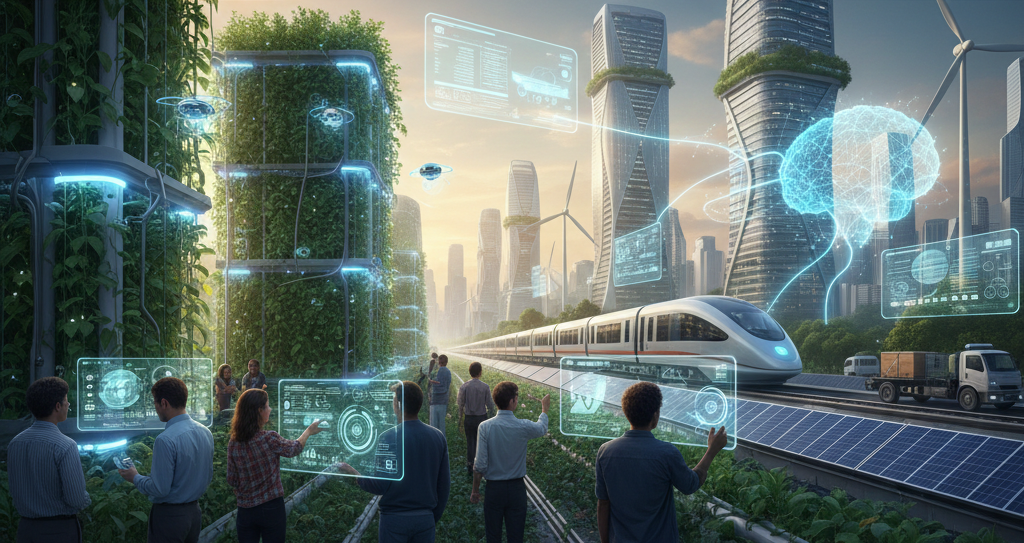
Throughout 2025, the conversation about technology was marked by discovery. Artificial intelligence surprised us; it was tested, integrated experimentally, and raised questions in all sectors. But 2026 marks a turning point: it is no longer about exploring possibilities, but about making real decisions. Governments, companies, and institutions are beginning to use these technologies to act, not just to analyze.
Rather than talking about new tools, 2026 forces us to embrace a key idea: technology is moving from promise to performance.
Artificial intelligence crosses the screen
Artificial intelligence will continue to be the dominant technological force in 2026, but with one clear difference from previous years: its impact will no longer be limited to the digital realm. It will cease to be a tool that merely answers questions and become a system capable of perceiving its environment, making decisions, and acting.
In this context, the integration of AI into the physical world (physical AI or embodied AI) is becoming increasingly relevant, where artificial intelligence is no longer just code but is incorporated into tangible objects. Robots, autonomous devices, and industrial systems are beginning to perceive their environment, make decisions, and act in spaces shared with people.
Added to this evolution is the advance towards multi-agent systems, a model in which multiple specialized agents collaborate to execute complex workflows. Instead of a centralized model, organizations are beginning to work with ecosystems of agents that coordinate, monitor, and act dynamically.
Beyond the technology itself, the most profound impact of artificial intelligence by 2026 will be on humans. AI does not abruptly eliminate jobs, but it does redefine tasks and transform work, automating the repetitive, accelerating the complex, and forcing people and organizations to rethink their role in an increasingly collaborative environment with technology.
When technology moves on its own
Autonomous transport is no longer a futuristic promise but is gradually becoming an everyday reality. Driverless vehicles are already operating in some cities around the world, and their adoption will continue to grow through 2026. Although their mass deployment will still take time, the direction is clear: autonomous mobility is beginning to become part of everyday life.
But the biggest impact is not only on private cars. Autonomous logistics is already transforming freight transport on a global scale: ships, trucks, and distribution systems that operate for longer hours, optimize routes, and reduce human error.
Infrastructure at its limits: energy, computing, and sustainability
The rapid growth of artificial intelligence has brought an uncomfortable reality to light: current technological infrastructure is beginning to fall short. The energy consumption of data centers and the demand for computing capacity are growing at a rate that challenges electrical grids and current sustainability models.
That is why, by 2026, the technological conversation will also revolve around how to sustain what we are building. It is no longer just a question of polluting less, but of developing solutions that allow us to repair and regenerate some of the accumulated environmental damage.
At the same time, the industry is committed to more efficient AI infrastructure models: distributed computing systems, intensive use of each unit of capacity, and new ways to concentrate power without triggering energy consumption. Efficiency is becoming as important as innovation.
Security and trust in an increasingly digital life
As more information, processes, and decisions migrate to digital environments, cybersecurity is becoming one of the most critical trends of 2026. Not as an add-on, but as a basic condition for operating.
Technologies such as confidential computing seek to protect data not only when it is stored or in transit, but even while it is being processed. This approach is key in a context of stricter regulations, data sovereignty, and intensive use of artificial intelligence in hybrid and multicloud architectures.
Trust also comes into play strongly. Digital provenance—verifying the origin and integrity of software, data, and AI-generated content—becomes key to combating misinformation, deepfakes, and hidden risks in increasingly complex technology chains.
2026: fewer promises, more decisions
The year 2026 will not be remembered for a specific technology, but rather for a change in mindset. The question is no longer what technology can do, but rather what we are willing to delegate to it. Artificial intelligence, infrastructure, and security no longer exist in the laboratory, but rather in daily operations.
Technology is starting to deliver. And with that, it also forces us to take on clearer responsibilities about how, why, and for whom we use it.