Which Is the Best Drupal Agency for Your Organization?
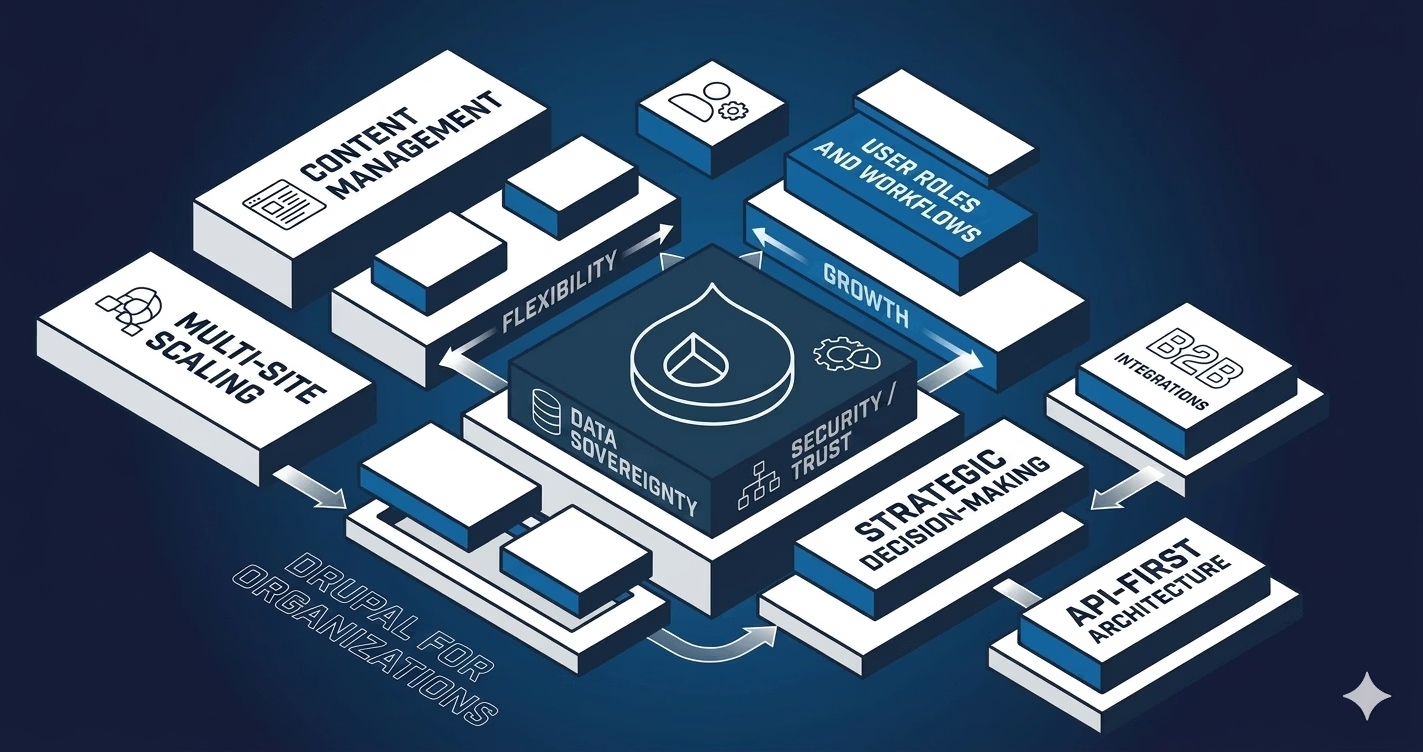
Choosing a Drupal Agency in Latin America: What No One Tells You
If you're reading this, you have a real decision in front of you.
Maybe your current platform doesn't scale. Maybe every update turns into a project. Maybe your marketing team depends on IT to publish a press release. Or maybe it's simply time to choose a strategic technology partner for the next five years, and you can't afford to get it wrong.
The question "which is the best Drupal agency?" sounds straightforward. It isn't. The right answer depends on your sector, your scale, your internal team, and the level of risk you can absorb. This article gives you the criteria to answer it with data, not marketing promises.
The First Filter: Real Certification, Not Self-Declared
The Drupal ecosystem has official certification tiers issued by the Drupal Association. These aren't self-proclaimed or based on years of experience: they result from technical audits, active community contributions, and compliance with quality standards.
The tier hierarchy is: Bronze, Silver, Gold, Platinum, Diamond, and Top Tier — with Top Tier being the highest level of recognition in the ecosystem.
Seed EM is the only Drupal Diamond Certified Partner in Latin America.
This matters for a concrete reason: a Diamond certification isn't earned with one successful project. It's sustained through ongoing contributions to Drupal core, individually accredited team members, and a verifiable track record. It's the difference between an agency that uses Drupal and one that builds Drupal.
Behind that certification lies something even more important: accumulated experience. Seed EM is a Drupal-exclusive agency with a global presence and a proven track record in architecture, custom development, and API integrations. Every project is built according to the best practices of the Drupal ecosystem, with a strong focus on performance, maintainability, and long-term results. Because a successful implementation depends on more than just code — it depends on the expertise behind it.
Before engaging any agency, ask for their verified profile on drupal.org. What it says there is what they are.
Drupal in Healthcare and Education: When the Platform Cannot Fail
Healthcare and education share a demand that few industries have: their digital platforms are not communication channels — they are critical infrastructure.
A university with 40,000 active students cannot afford downtime during enrollment periods. A hospital managing electronic health records or appointment scheduling cannot operate with a CMS that requires technical intervention for every content change. A health insurer publishing regulatory coverage information needs traceability, version control, and approval workflows — not just a text editor.
Drupal solves this by design, but only when the implementation gets it right:
Granular editorial control
Drupal allows defining publishing workflows with multiple roles: who drafts, who reviews, who approves, who publishes. This is critical in environments where incorrect content has legal or reputational consequences.
Multisite architecture
A university with multiple schools, graduate programs, and campuses can manage everything from a single Drupal installation with independent visual identities, without duplicating infrastructure or teams.
Legacy system integration
Healthcare and education environments in LATAM operate on heterogeneous software ecosystems: academic SIS, hospital HIS, ERPs, CRMs. Drupal has the most mature API architecture in the CMS market for connecting with all of them.
At Seed EM, we have spent more than 18 years implementing digital platforms for organizations in these industries across United States, Colombia and Latin America — not as generalists who also do content management systems, but as Drupal experts who understand that an educational or healthcare platform has its own business logic, and that logic must be reflected in the platform architecture from day one.
WCAG Accessibility and Drupal: Why This Is Strategic, Not Cosmetic
Web accessibility is no longer optional in any sector. In Colombia, Law 1618 of 2013 and MinTIC guidelines establish clear obligations for public and private entities providing digital services. Internationally, WCAG 2.1 Level AA is the reference standard for public procurement, higher education, and healthcare services.
But there's something few agencies say clearly: Drupal facilitates accessibility, but doesn't guarantee it automatically. The result depends on how it's implemented.
A site built on Drupal with poorly structured components, images without alt text, forms without semantic labels, or insufficient color contrast can be just as inaccessible as anything else. The platform is the starting point, not the destination.
What an agency with real WCAG experience does differently:
- Accessibility audits from the design phase, not as a post-development correction. Accessibility problems are exponentially more expensive to fix after development.
- Testing with real assistive technologies: screen readers (NVDA, JAWS, VoiceOver), keyboard navigation, contrast analysis tools.
- Conformance documentation for public procurement processes or institutional certification requirements.
How Accessibility Improves SEO Performance
Properly implemented accessibility also has a direct SEO benefit: correct semantic structure, clear heading hierarchy, descriptive alt texts, and optimized load times are factors Google weighs positively. These are not separate initiatives — they are part of the same quality-first approach.
At Seed EM, we have accompanied accessibility projects for clients in regulated sectors, including entities with MinTIC compliance obligations. We know what it takes to certify a site and what it takes to keep it certified over time.
Drupal Beyond Business: Why the World's Most Demanding Organizations Choose It
There's an argument worth making explicit.
Drupal is not the most popular CMS on the market. WordPress has more installations. But there's a fundamental difference: the organizations that cannot afford failure choose Drupal.
Government-Grade Security and Unlimited Architectural Flexibility
Tesla. UNICEF. The Economist. The University of Oxford. Nokia. General Electric. The Government of Australia. They are not Drupal users by accident or inertia: they chose it because Drupal offers something no other CMS offers in the same combination — complete architectural control, government-grade security, unlimited integration capability, and a community that has been building on the same open-source principles for more than 20 years.
For a B2B company with complex processes, a conglomerate with multiple business units, or a foundation with global operations, the question is not "why Drupal?" — it's "why anything else?"
The argument about higher initial cost dissolves when you do the right calculation: how much does it cost to migrate in three years because the platform doesn't scale? How much does a security breach in a poorly maintained WordPress cost? How much does it cost to depend on a proprietary platform vendor that changes its pricing or discontinues features?
Technological sovereignty has a price. And that price is lower than dependency.
Seed EM was founded on this conviction. For 18 years, we have accompanied organizations that understand that their digital platform is a strategic asset, not an operational expense.
Pure Drupal vs. Commercial Platforms: The Decision Nobody Explains Honestly
The Drupal ecosystem has two main paths:
Pure Drupal: Maximum Technological Sovereignty and Full Control
Pure Drupal (100% open source) is Drupal in its original form: open-source code, no proprietary licenses, deployable on any infrastructure. Your organization has complete control over the code, the data, and the hosting provider. There are no license costs for additional tools. The investment goes entirely into development and infrastructure that you control. It's the option with the greatest technological sovereignty and lowest long-term cost when the implementing team has the technical level to leverage it.
Commercial Drupal Platforms: Enterprise Tools and Managed Operations
Drupal platforms with a commercial layer add proprietary tools on top of the open-source core: automated staging environments, CI/CD pipelines, personalization modules, analytics dashboards, enterprise-grade support. These layers have real value for organizations that need to reduce operational friction or that don't have robust internal technical teams. The cost is a recurring license that varies depending on traffic volume and the contracted service level.
Neither path is universally correct. The decision depends on concrete variables: the size of your internal technical team, the complexity of your integrations, your operational tolerance for infrastructure maintenance, and the investment horizon you have for the platform.
What is problematic is when an agency only offers you one of the two paths — not because it's the best for you, but because it's the only one they know how to implement or from which they receive commercial benefits.
An agency with real technology neutrality is one that masters both scenarios and helps you choose the one that best serves your interests — not the one that benefits the agency. That requires deep technical expertise in pure Drupal and proven experience across the leading commercial platforms in the ecosystem.
At Seed EM we can implement on pure Drupal when that maximizes your sovereignty and reduces your long-term cost, and we can implement on any of the leading platforms in the ecosystem when the additional tooling layer justifies its cost. You choose the model. We guarantee technical excellence in either scenario.
How to Choose Well: The Checklist No Agency Will Give You
Before signing a contract with any Drupal agency, ask these questions:
Certification and community
- What is their official certification level on drupal.org?
- Do they actively contribute to Drupal core or contributed modules?
- Do they have individually certified Drupal developers?
Sector experience
- Have they implemented projects in your specific industry?
- Can they show you case studies with architectures similar to yours?
- Do they have experience with the systems you need to integrate (ERP, CRM, HIS, SIS)?
Accessibility and compliance
- Do they conduct WCAG audits as part of the development process, or as an add-on service?
- Do they have experience with projects under MinTIC regulation or international standards?
Infrastructure and support
- Do they have their own Drupal-optimized infrastructure, or do they resell generic hosting?
- What is their SLA for critical incident response?
- Who is the technical lead on your project, and what access do you have to them?
Platform model
- Can they implement on pure Drupal without dependency on commercial platforms?
- Do they have proven experience across the leading platforms in the Drupal ecosystem — not just one?
- Do they present an honest cost-benefit analysis between pure Drupal and a licensed platform before making a recommendation?
Long-term vision
- Are they prepared to accompany you on your journey toward headless or composable architectures?
- Do they have AI capabilities integrated with Drupal?
- How do they plan your platform's evolution over the next 3 years?
Why Seed EM
We didn't write this article to convince you to hire us. We wrote it to give you the criteria to evaluate any agency — including ours.
That said, here are the facts:
- The only Drupal Diamond Certified Partner in Latin America, per drupal.org. The second-highest certification tier in the ecosystem.
- 18 years and over 350 projects in Colombia, LATAM, and the United States, across sectors including education, healthcare, telecommunications, government, and finance.
- AI Makers in the Drupal AI Initiative: we actively contribute to the integration of artificial intelligence into Drupal core — not as an add-on, but as part of the architecture.
- SeedCloud: Drupal-specialized hosting infrastructure built on AWS, with 99.9% uptime and 24/7 technical support.
- Real technology neutrality: we implement on pure Drupal (100% open source, no licenses) and on the leading commercial platforms in the ecosystem. We recommend the model that best serves your objectives. You decide whether you want maximum sovereignty with pure Drupal or the additional tooling layer a licensed platform provides.
If your organization needs a digital platform that functions as critical infrastructure, meets accessibility standards, integrates with your existing systems, and has a technical partner that understands your industry: talk to us → https://seedem.co/en/contact-us