
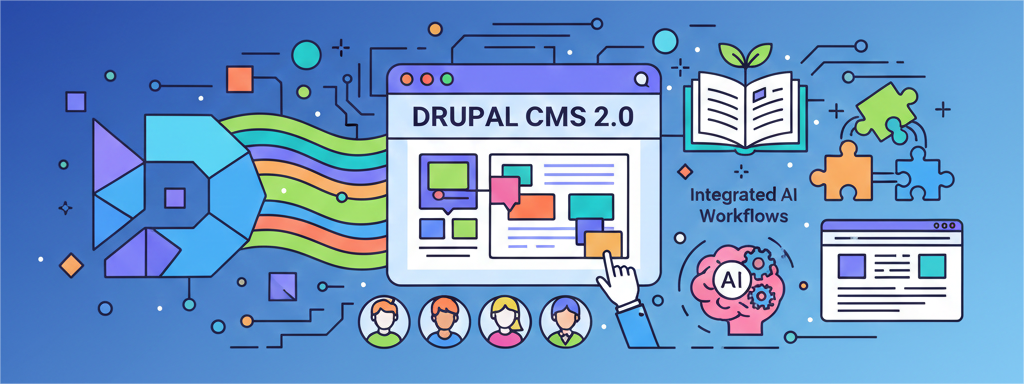
Yesterday, on January 28, 2026, Drupal CMS 2.0 was officially launched, marking one of the most important milestones in Drupal's 25-year history. This new version is not just an update: it is a change in the user experience that seeks to address a long-standing criticism of the platform—that it was powerful, yes, but difficult to use.
With this new version, Drupal begins to tell a different story: powerful and easy.
What is Drupal CMS, and why does it matter?
Drupal CMS is a version of Drupal designed to make creating websites much more agile from the start, without the configuration process becoming a barrier.
This addresses one of the most frequent criticisms: its learning curve. With 2.0, Drupal not only retains the robustness that developers and large organizations value, but also expands who can actively participate in building and managing the site, including marketing teams and content creators.
Key new features in Drupal CMS 2.0
The star of the show: Drupal Canvas
The most important new feature in Drupal CMS 2.0 is Drupal Canvas, a drag-and-drop visual editor that is installed by default.
With Canvas, you can:
- Drag and drop components directly onto the page
- See changes in real time without switching between administration and final view
- Build complete pages without writing code
- Use predefined blocks such as heroes, cards, testimonials, menus, and more
No more switching back and forth between administration forms and previews. Now, building happens directly on the page, with a much more fluid and visually focused experience.
In other words, it's a more natural way of working for content creators, without limiting what the system can do behind the scenes.
Site templates: start with something real, not from scratch
Another key feature of Drupal CMS 2.0 is site templates. Instead of installing Drupal and starting to configure everything manually, you can now start from a site that is already structured for common use cases.
These templates include:
- Ready-made designs
- Configured content models
- Defined components and styles
They are installed as a starting point and can then be freely adapted to the needs of the project. Instead of starting with a blank slate, the team starts with a coherent structure on which to build.
AI integrated into the workflow
Drupal CMS 2.0 also adds artificial intelligence features directly integrated into the building and editing experience.
Among the possibilities that this offers are:
- Providing chatbot-style assistance for configuration tasks
- Generating content drafts
- Suggesting alternative texts for images and improving accessibility
AI does not appear as an isolated add-on, but as a tool that accompanies the daily work of those who build and manage the site.
Ready-to-use features without long configurations
Drupal CMS 2.0 also makes it easy to add new features without having to go through extensive configuration processes. Through Recipes, many of these tasks that previously involved multiple steps are now applied as ready-made configurations.
Instead of rebuilding the same thing over and over again, you can apply recipes that get everything ready in a single process:
- Necessary modules
- Content types
- Permissions
- Common integrations
The experience goes from relying on memory or internal documentation to relying on reusable configurations. This reduces preparation time and makes projects more consistent with each other.
Smoother for marketing, but still with what tech teams love
One of the big changes is who Drupal empowers.
Historically, it was mainly a developer tool. With Drupal CMS 2.0, marketing and content teams get way more autonomy:
- They can build pages without needing tech tickets for every tweak
- They see changes in real time
- They work with reusable components instead of layouts from scratch
Meanwhile, underneath it all is the same solid foundation that has made Drupal the choice of governments, universities, and large organizations: security, scalability, and control.
Drupal CMS 2.0 does not change the essence of Drupal. It changes who can take advantage of it and how quickly they can do so.