
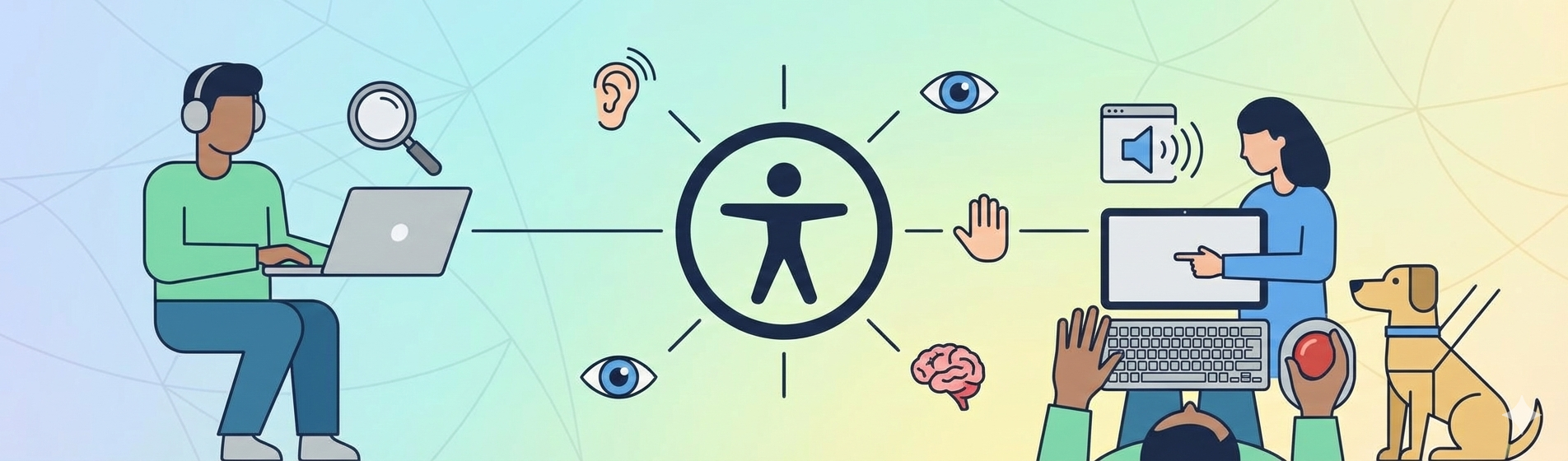
Today, a website must not only look good: it must be usable by everyone.
More and more people are accessing information from very different contexts: screen readers, cell phones, slow connections, or keyboards instead of a mouse.
Talking about web accessibility is no longer optional. It's about inclusion, experience, and digital quality.
What is (and what isn't) web accessibility
Web accessibility consists of designing and building sites that can be used by people with different visual, auditory, motor, or cognitive abilities.
But it's not just about designing for “special cases,” nor is it about making sites more limited or less attractive. Nor is it an issue exclusively for developers or technical teams.
An accessible website benefits everyone. It improves reading, navigation, content comprehension, and the overall experience. In addition, it often brings very specific benefits: better usability, greater reach, better SEO performance, and less friction for conversion.
When a site is accessible, it simply works better.
Basic principles for an accessible website
Without getting into complex technical standards, an accessible website usually complies with four key ideas:
- Perceptible: content must be viewable or audible in different ways.
- Operable: navigation should not depend solely on the mouse.
- Understandable: information and interactions must be clear and predictable.
- Robust: the site must function correctly on different devices and technologies.
These principles are not intended to complicate the design, but to make it clearer, more usable, and more consistent.
Small changes that make a big difference
You don't need to redo your entire site to start improving its accessibility. A few simple actions can make a big difference:
- Check the contrast between text and background.
- Use well-structured headings.
- Add alternative text to images.
- Test navigation using only the keyboard.
- Evaluate whether forms can be understood without additional explanations.
Accessibility is not about making things perfect, but about making them better. It's about changing the way we think about design and technology.
Designing for more people always pays off
When we design with more people in mind, the impact is always greater. Accessibility is not an additional layer or an isolated requirement: it is a sign of quality, empathy, and long-term vision.
If you want to learn more about how to apply web accessibility based on international standards and find out how platforms such as Drupal facilitate this process, we invite you to read our article on web accessibility with Drupal and WCAG, where we address the issue from a more technical and practical perspective.